


Release time:2026-05-27
Author:
Preview:0
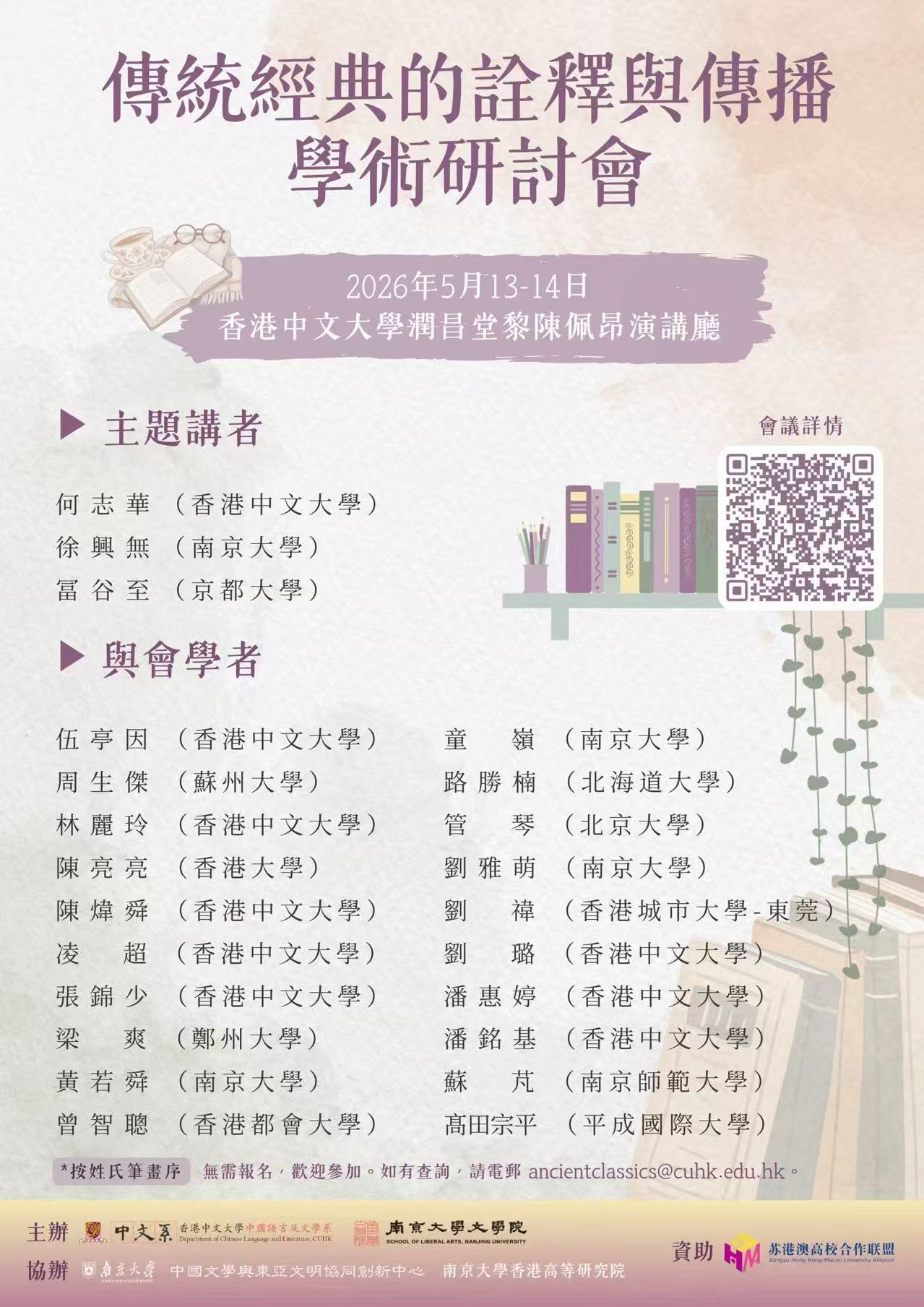
Organized by the Department of Chinese Language and Literature, CUHK, and the School of Liberal Arts, Nanjing University, with support from the Jiangsu-Hong Kong-Macao University Alliance and co-organized by the Collaborative Innovation Center for Chinese Literature and East Asian Civilization (Nanjing University) and the Hong Kong Institute for Advanced Study (Nanjing University), the symposium was held on May 13–14, 2026, at the Lee Choon Chiang Lecture Theatre, Yun Cheung Hall, CUHK. The event brought together 23 scholars from 12 institutions, including CUHK, Nanjing University, Kyoto University, Peking University, City University of Hong Kong, The University of Hong Kong, Soochow University, Zhengzhou University, Hong Kong Metropolitan University, Nanjing Normal University, Hokkaido University, and Heisei International University. Focusing on cross-temporal hermeneutics and transmission mechanisms of classical texts, the symposium featured open sessions with keynote speeches, panel discussions, and presentations on topics such as the formation of core classics, philosophical interpretation, exegetical studies, East Asian sinology, Buddhist textual compilation, shifts in poetic paradigms, and prosodic criticism.
The opening ceremony featured addresses by co-conveners Professor Poon Ming Kay (Chair, Department of Chinese Language and Literature, CUHK) and Professor Tong Ling (Associate Dean, School of Liberal Arts, Nanjing University), who reviewed the symposium’s origins and the long-standing scholarly ties between the two departments. Keynote speeches were delivered by Professor Xu Xingwu (Nanjing University), Professor Ho Che Wah (CUHK), and Professor Tonomura Mamoru (Kyoto University).
Panel 1 (Chair: Su Peng; Discussant: Liu Yameng)
Zhou Shengjie examined Joseph Needham’s collection and use of Chinese encyclopedias to demonstrate China’s scientific advancement. Poon Ming Kay analyzed Guo Pu’s Commentary on the Erya: Explanation of Fish, highlighting empirical observation, classification, and integration of text and experience. Tong Ling reassessed Erzhu Rong, arguing that despite his massacre of the imperial family, he stabilized northern China, with his subordinates Gao Huan and Yuwen Tai laying the foundation for later dynasties.
Panel 2 (Chair: Zhou Shengjie; Discussant: Wu Tingyin)
Huang Ruoshu explored the relationship between female learning and political interference in the Han-Wei period. Chen Weishun compared versions of Nie Gannu’s Northern Wilderness Verse, finding paradigmatic value in his revisions despite atypical circumstances. Liu Yi traced the classification of Compendium of Exceptional Sutras to Sengyou’s Buddhist compilations. Liu Lu demonstrated Wang Niansun’s construction of an exegetical axiom system in Shi Da. Pan Huiting compared editions of Ota Kata’s Hanfeizi Yicui, revealing his deepened understanding of Han Fei’s “statecraft.”
Panel 3 (Chair: Lyu Jiahui; Discussant: Huang Ruoshu)
Su Peng analyzed a five-line Japanese version of Xiang Yu’s “Song of Gaixia,” inferring a pre-Wei-Jin origin. Ling Chao reinterpreted Liu Xie’s “eclecticism” as a central principle integrating heterogeneous literary elements. Liang Shuang argued that Yao Silian actively participated in early Tang cultural integration. Chen Liangliang examined Cheng Tingzuo’s Lotus Island, revealing his use of drama to conceptualize a maritime strategy against foreign powers. Zeng Zhicong discussed Republican-era prosodic commentaries and anthologies, reflecting the reception and transformation of Qing “tu pu” studies.
Panel 4 (Chair: Ling Chao; Discussant: Liang Shuang)
Takada Sōhei discovered a lost passage from Xiuwendian Yulan in a Japanese manuscript, illuminating its medieval reception in Japan. Guan Qin discussed the establishment of Du Fu as the poetic paradigm in the Song dynasty, with Huang Tingjian as a precursor. Liu Yameng reinterpreted Han Yu’s “On the Teacher,” arguing that Han used the power of the teacher to rescue the Way.
Panel 5 (Chair: Guan Qin; Discussant: Liu Lu)
Lu Shengnan examined a variant reading in Wuxing Dayi, identifying it as a miscopied Xu Shen commentary and highlighting the value of Japanese manuscripts. Lin Liling analyzed citations of the Analects in the Veritable Records of the Joseon Dynasty, showing its transformation into political language and evaluative criterion. Wu Tingyin studied Tsukada Hiko’s Commentary on the Laozi, revealing his system of reconciling Confucius and Laozi as an external perspective on Chinese classical studies.
Closing Session
Xu Xingwu praised the symposium’s return to sincere discussion and the outstanding performance of early-career scholars. Ho Che Wah commended young scholars’ rigorous methods and hoped for continued close reading and cross-regional dialogue. Poon Ming Kay emphasized the cross-temporal, cross-textual, cross-regional, and cross-cultural vision, looking forward to continued dialogue on the classics.